Last week I had a pleasure of speaking at the She Says event in the Shoreditch House. The subject was pitching for the new business and how to do it well. It was really great! I shared the stage with Karla Morales from The Art of New Business who talked all about the different ways of raising awareness about your offering and attracting new opportunities. We also had Caroline Goyder who is the confidence and voice expert and author of the book ‘Gravitas’. She shared some fun and very useful exercises to calm your nerves before the pitch as well as ‘silly’ (as she calls it) tool for finding out whether you’re a cat (task focused and independent) or dog (relationship focused and friendly).
All of our talks had one thing in common: differentiation. To win new business you need to stand out from the crowd. And to be honest the best way to stand out is to create a great rapport and human connection. At the end of the day ‘People buy People’ so if you won’t connect on a deeper human level, you won’t be bought.
Whoever you speak to, whether this is on a client’s side or the ‘pitcher’s’ side, they all admit that pitching is less about the standard of an actual presentation but more about people behind it. A couple of weeks ago I have attended an event on client-agency relationship hosted by PRCA and Question&Retain and obviously the moment of pitching for business took up quite a lot of the discussion time. Actually, Question&Retain have run a survey within various communications agencies on the subject of the client-agency relationship. The first question was ‘What is the most important factor in making the client agency relationship work?’ The most popular answer was ‘CHEMISTRY’.
I know, it sounds a bit cliché but it is fundamentally admitting that really the human factor is more important than great ideas or an amazing track record. In fact, one of the panellists on the event was Hugh Davies, Director of Corporate Affairs, Three. He described their recent choice of the new agency. They had 10 different companies pitching and the one that won wasn’t the one with the greatest ideas but the one with the greatest presentation. The human factor clearly differentiated them from their competition.
And this was also the theme at the She Says event in the Shoreditch House. Whatever service or product you’re selling there will be many other companies with the same or similar offering. So you need to find a clear way of standing out from the crowd.
My bit was to talk about the science behind the decision making process during the pitching situation. So although Hugh from Three stated that they have consciously decided that the human factor was crucial, what actually happens is that we are subconsciously influenced by people and surroundings present at the moment of a decision. So how you can control this influence and therefore increase your chances of permanently engraving yourself in your client’s mind?
It all starts with UNDERSTANDING your audience. I’m not only talking about doing research on a company you’re pitching to but more importantly researching people behind the company. This way you will increase your chances of building a strong rapport. Find out what are their interests, which football team they support, what’s important to them, where do they socialise etc. This will help you in the next step: COMMUNICATION.
In this step it is crucial to be consistent with the brand/company’s values and mission statement (both yours and the client’s) as well as consistent with the individual characteristics of the people behind the brand. Of course, I am not asking you to play a role and pretend to be someone you’re not. Always be yourself but accentuate those personality characteristics, behaviours and interests consistent with the client’s brand. Basically the more familiar and similar to the client in personality and behaviour you are, the higher the likelihood you will be liked and you will create a strong rapport; and the stronger the personal liking and rapport, the higher the chance of winning the pitch.
It comes from 2 well known psychological effects: familiarity effect and similarity effect. The familiarity effect basically states that the more you are exposed to something, the more you like it. So if you are to use examples to illustrate your point that are related to your client’s personal interests, you are activating familiarity effect and therefore you and your proposition are liked more. The similarity effect explains that the more similar characteristics, behaviours or interests someone or something has to us, the higher the possibility that we will like them/it. This is where the knowledge of the people behind the brand comes in handy. If the decision maker is an Arsenal fan, wear red tie rather than blue one, mention the recent game (only if the score was positive for Arsenal) or use football to illustrate your point. This will show that you share similar interests and therefore increase your chances of being liked.
You have two main tools to create strong rapport and subconsciously influence client’s decision making: ENVIRONMENT and YOU.
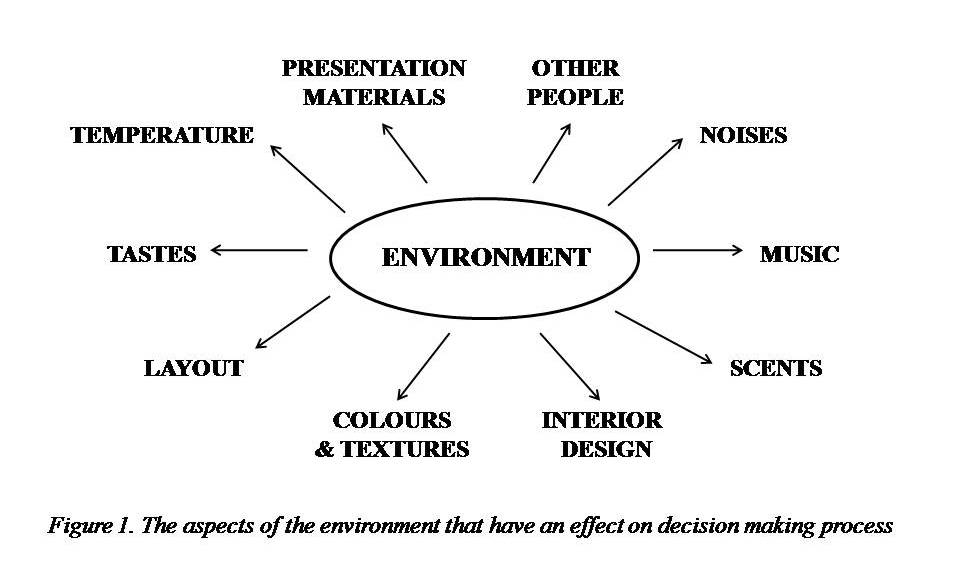
Various elements of the surroundings in which the pitch takes place can affect your chances of winning the business. These seemingly unimportant details like room temperature, texture of the floor, scents and music (see Figure 1) are subconsciously perceived and analysed by our minds. Any associations with these elements are unfortunately or fortunately transferred to you during your pitch. This isn’t something that your client is aware of or can control; it just happens in their mind.
For example, a study published in 2008 in Science showed that holding a warm drink in your hand can make you evaluate someone’s personality as ‘warmer’ (more generous and caring). It might seem weird but try it next time you’re having a meeting with a potential new client. Offer them a hot coffee rather than a glass of water and see what happens. Or simply observe the different effects of meetings in which the client chose hot drink as oppose to cold drink.
Another great example is a study published in 2009 in Science on the effect of red and blue on our cognitive abilities. It showed that colour red induces avoidance motivation and therefore improves performance on detail-oriented tasks; whereas colour blue induces approach motivation and improves performance on creative tasks. One of their experiments tested these effects as applied to advertising. The researchers have created a few camera ads manipulating the background colour (red vs. blue) and information included in the ad (specific product features vs. remotely related with product associations, e.g. holiday picture). They have found that if the ad presented specific product features (detail-oriented), the red background made the ad more favourable and effective for participants. Whereas when the ad contained remotely related to product associations (creative), the blue background was more effective. This study shows that even such a trivial thing as alternating the background colour of your presentation slides depending on the information presented might improve your chances of winning the pitch.
So next time you have a pitch or even meeting with a potential new client, take a look at the Figure 1 and see which aspects of the environment you can control to improve your chances of winning.
The second, but in my opinion most important, tool is YOU. There are many aspects of YOU (see Figure 2) that can subconsciously influence your client’s decision. Some of them I have already discussed earlier: personality, behaviour and interest. However, your non-verbal communication is much more powerful. It plays a crucial role in the first impression and throughout the rapport building process. 93% of our communication is non-verbal and a vast majority of it is only perceived on the subconscious level.
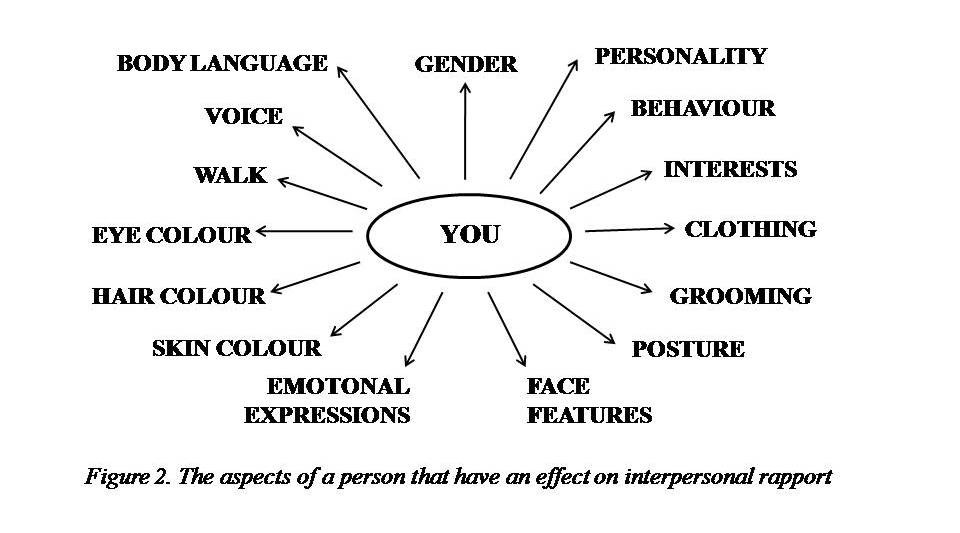
The first impression is actually completely subconscious and based solely on non-verbal cues. The whole process lasts merely 3 SECONDS and the perceiver’s mind takes into account such information as colour of the skin, colour of the hair, shape of the face, emotions expressed, posture, clothing and grooming. On some occasions the walk and voice are taken into account but never the words you use. This comes only after the observer made up their mind about you.
This isn’t the process we can stop or pause in our minds. It just happens and the only thing we can do is to make sure that we come across as we want to be perceived. This includes working on our personal image, posture, emotional expression and the rest of your non-verbal communication.
A recent study published a month ago in Psychology & Marketing showed that the information presented by communicator wearing red clothing was perceived as more accurate than when wearing white or blue. The participants were also completely unaware of this effect therefore proving that the effect was completely subconscious.
So when you’re preparing for a pitch or a client’s meeting, think about what you wear and how you’re going to walk to a room. Practice it with your colleagues, your friends or in front of a mirror.
Don’t leave anything to chance! If you can influence your client’s subconscious so they love you more than your competitors, why shouldn’t you do it?!
This article explores just some of the ways in which environment and your personal presentation can influence your chances of winning a new piece of business. Every situation is different however so if you want to make sure that you use your surroundings and your personal presentation to your advantage, get in touch and we can help you do just that.